
As the afternoon sun dips below the Smoky Mountain horizon, casting a warm golden hue across Alcoa, Tennessee, the backyard transforms. In Blount County, mild spring evenings and warm summer nights offer the perfect backdrop for outdoor living. Homeowners invest significant thought and capital into crafting expansive safe outdoor spaces, selecting premium composite boards, arranging comfortable sectionals, and positioning outdoor kitchens. Yet, as twilight yields to night, a common design flaw frequently emerges: the space either disappears into total darkness or gets blasted by the harsh, blinding glare of a high-wattage security floodlight.
Relying on a floodlight to illuminate a deck is like using a stadium spotlight to read a book in bed. Mounted high on an exterior wall, motion-activated floodlights cast deep, unflattering shadows, blind anyone sitting at the dining table, and attract every flying insect within a two-mile radius. Rather than extending your living space into the night, harsh lighting forces family and guests back indoors.
True after-dark living requires a shift in perspective. Moving away from utilitarian security lighting toward architectural low-voltage illumination allows you to create a warm, inviting outdoor sanctuary. By thoughtfully layering light across your deck’s structural features, you can turn your outdoor living space into a magical, usable retreat long after the sun goes down.
The Architecture of Light: The Four Layers of Safe Outdoor Illumination
Professional lighting designers rarely rely on a single overhead light source. Instead, they create depth, mood, and functional clarity by layering four distinct types of safe illumination across a space:
- Ambient Lighting: The base layer of soft, overall illumination that mimics moonlight. It provides enough light to see faces clearly without causing eye fatigue or glare.
- Task Lighting: Targeted, practical illumination focused on high-activity zones, such as grilling stations, outdoor kitchens, and bar counters.
- Accent Lighting: Decorative lighting used to draw attention to architectural details, such as majestic timber posts, stone pillars, or custom pergola rafters.
- Safety and Wayfinding Lighting: Functional lighting integrated into level transitions, stair risers, perimeter edges, and walkway paths to prevent trips and falls.
When these four layers are engineered into a low-voltage (12-volt) system, the result is a balanced, glare-free environment where the light fixtures themselves disappear, leaving behind only the subtle, inviting glow of the space.
Inspired Deck Lighting Ideas for Alcoa Homes
Transforming your outdoor space requires choosing the right fixtures for specific structural zones. Here are five sophisticated lighting techniques that elevate after-dark living without overwhelming the senses.
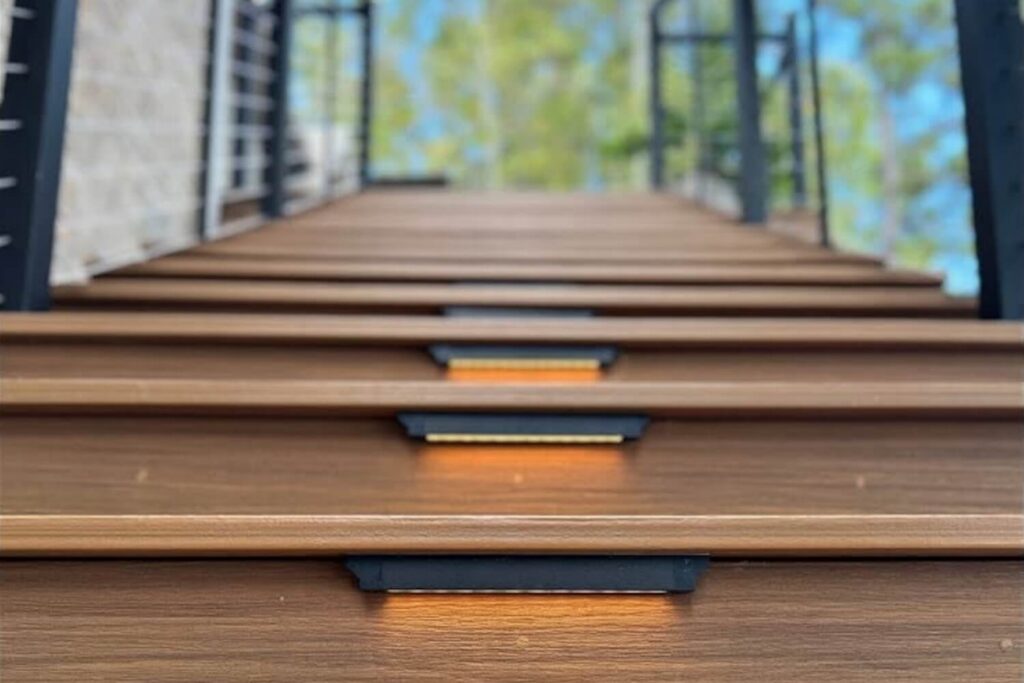
1. Integrated Stair Riser Lights: Safety Meets Subtlety
Stairs represent one of the highest risk areas on any elevated deck, especially when guests are navigating level changes in the dark. Traditional floodlights cast dark shadows over step treads, making depth perception difficult.
Flush-mounted LED riser lights solve this issue with elegant precision. Installed directly into the vertical riser of each step, these small, low-profile fixtures direct a soft wash of warm light downward onto the horizontal tread below. Because the light source is shielded, it illuminates the footing path clearly without shining into the eyes of people walking up the stairs. The result is an unshakeable sense of security that looks like a high-end luxury resort feature.
2. Under-Rail and Post Cap Illumination: Defining the Perimeter
Defining the boundaries of your deck after dark is essential for creating a cozy, contained atmosphere. Post cap lights, fixtures integrated directly into the top cap of perimeter posts, cast a gentle, downward perimeter glow.
For an even sleeker, more modern aesthetic, under-rail strip lighting can be concealed along the underside of the top railing channel. Utilizing continuous micro-LED channels hidden beneath the rail casts a warm, unbroken curtain of light down the pickets, glass panels, or cable infill. This highlights the architectural craftsmanship of your railing system while outlining the deck’s perimeter without obstructing your view of the night sky.
3. In-Deck Flush Recessed Puck Lights: Floor zonation
Large, open-concept decks can feel sprawling and ambiguous in the dark. Compact, flush-mounted LED puck lights, often no larger than a coin, can be installed directly into the deck surface to delineate specific functional zones.
Placing recessed puck lights along the outer perimeter of the deck boards creates a soft floor outline, preventing accidental steps off the edge. They can also be used to outline transition zones, such as the perimeter of a sunken seating area or the entrance to a covered screen room. Engineered with heavy-duty brass or stainless steel covers and frosted lenses, these durable fixtures sit completely flush with composite boards, allowing foot traffic and patio furniture to slide over them smoothly.
4. Pergola Rafter and Post Uplighting: Vertical Dimension
If your Alcoa deck includes a custom pergola or covered roof structure, ignoring the vertical overhead elements is a missed opportunity. A deck without vertical light can feel flat and visually heavy.
Mounting compact LED uplights at the base of pergola posts washes light upward along the vertical columns, accentuating the natural texture of the wood or aluminum. Additionally, micro-spotlights or hidden strip lighting can be tucked into the overhead cross-rafters. This creates a soft, indirect ceiling glow that reflects warm light back down onto the patio below, mimicking the cozy feel of an indoor dining room.
5. Connecting Deck to Landscape: Eliminating the “Black Wall” Effect
A common mistake in deck lighting design is focusing exclusively on the deck itself while leaving the surrounding yard in pitch darkness. Looking out from a brightly lit deck into a black abyss creates a jarring visual boundary known as the “black wall” effect, making the deck feel isolated and small.
To create visual harmony, extend your low-voltage lighting system into the adjacent landscape. Placing subtle uplights at the base of dogwood trees, Japanese maples, or stone retaining walls frames your backyard’s natural features. Illuminating garden beds and perimeter trees draws the eye outward, expanding the perceived boundary of your living area and integrating your deck seamlessly with the East Tennessee landscape.
The Invisible Magic: Why LEDS Lighting Must Be Planned During Framing
The difference between an amateur lighting installation and a professional architectural masterwork comes down to one crucial factor: when the lighting is planned.
Many homeowners treat deck lighting as an afterthought, attempting to add fixtures after the deck boards, railings, and fascia are already installed. Retrofitting a completed deck invariably leads to exposed conduit running down support posts, unsightly wires stapled under joists, surface-mounted transformer boxes, and drilled holes that compromise board seals and warranties.
To achieve a clean aesthetic, lighting must be engineered into the structural framing phase of construction. At LeBlanc Decks, the philosophy is that lighting should serve as an integrated component of the overall build. During the framing stage, low-voltage wiring harness channels are drilled through the centers of structural joists, and primary feed lines are routed up inside hollow aluminum posts before any deck boards are secured.
By integrating safe wire management into the structural frame, every cable remains completely invisible. Fixture housings sit perfectly flush with composite deck surfaces, post caps fit snugly without binding wires, and the entire electrical system remains protected from moisture, rodents, and physical wear.
Engineering for East Tennessee Weather and Energy Efficiency
Alcoa experiences a full spectrum of weather conditions, from humid summer rainstorms to winter freezes and intense UV exposure. Outdoor electrical components must be built to withstand these environmental stresses without failing or requiring frequent maintenance.
The Advantages of Low-Voltage (12V) LED Systems
Modern deck lighting relies almost exclusively on 12-volt low-voltage direct current (DC) systems powered by a step-down transformer connected to a standard 120-volt household outlet. Low-voltage LED systems offer massive advantages over traditional line-voltage lighting:
- Maximum Safety: 12-volt currents pose zero risk of severe electrical shock, making them exceptionally safe around pets, children, and wet poolside environments.
- Extreme Energy Efficiency: Solid-state LED fixtures consume up to 80% less electricity than traditional incandescent or halogen bulbs. Running a comprehensive 15-fixture deck lighting system costs only a few dollars per month in electricity.
- Minimal Heat Emission: High-quality LEDs generate almost no heat, preventing thermal discoloration on composite deck boards and eliminating the risk of burns if touched by bare hands or paws.
- Decades of Bulb Life: Commercial-grade LED modules are rated for 30,000 to 50,000 hours of continuous operation, meaning if you run your deck lights for four hours every evening, the bulbs can last over 20 years without needing replacement.
Weatherproofing and Smart Control Integration
High-performance systems feature solid cast-brass or powder-coated aluminum fixture housings, sealed silicone gaskets, and IP67-rated waterproof wire connectors. These heavy-duty components resist corrosion, moisture penetration, and thermal cracking through seasons of temperature swings.
Specializing in high-performance composite and mineral-based structures across East Tennessee, LeBlanc Decks utilizes weather-sealed low-voltage LED systems that stand up to humid Alcoa summers while offering modern smart control integrations:
- Astronomical Timers: Smart transformers automatically adjust on and off times daily based on Alcoa’s exact sunset and sunrise schedule, eliminating the need to manually adjust timers for daylight saving time.
- Multi-Zone Dimming: Divide your deck lighting into independent zones, dimming the dining table lighting while keeping stair riser lights bright for safety.
- Smartphone and Voice Control: Adjust brightness, set custom evening scenes, or control zones remotely using intuitive smartphone apps or smart home systems.
Boosting Curb Appeal and Home Value in Alcoa, TN
Investing in an engineered deck lighting system provides immediate returns in both daily lifestyle and financial equity. In suburban real estate markets like Alcoa, high-end outdoor living features are a major selling point.
A deck illuminated with subtle, layered low-voltage lighting transforms the nighttime curb appeal of your home. In online real estate listings and twilight photography, a professionally lit outdoor retreat communicates quality, craftsmanship, and attention to detail. Prospective buyers recognize a move-in-ready sanctuary where they can entertain immediately without needing to perform upgrades.
Choosing a specialized custom builder like LeBlanc Decks ensures your outdoor sanctuary is designed with architectural precision, backed by daily digital project updates and robust workmanship warranties. Their process-driven safe construction methodology ensures every fixture, wire, and structural component is installed to exceed building codes, delivering an outdoor room that performs day and night flawlessly.
Frequently Asked Questions (FAQ)
Why should I choose low-voltage LED deck lighting over solar-powered lights?
Solar-powered deck lights depend entirely on direct sunlight to charge small internal batteries, which often leads to dim, unreliable performance on cloudy days or during winter months. Low-voltage (12V) hardwired LED systems are connected to your home’s electrical panel via a transformer, providing consistent, bright, and controllable illumination 365 days a year regardless of weather.
Can deck lighting be installed on an existing deck, or must it be new construction?
While lighting is best integrated during new construction or resurfacing when structural framing is fully exposed, high-quality low-voltage lighting can be retrofitted onto existing decks. Professional builders use specialized wire-routing techniques, notch channels beneath top rails, and use surface-mounted riser fixtures to hide wiring as discreetly as possible.
Will integrated deck lighting attract bugs and mosquitoes at night?
Insects are primarily attracted to the intense heat and ultraviolet (UV) light emitted by traditional incandescent or halogen floodlights. Modern low-voltage LED fixtures emit virtually no UV light or heat. Furthermore, choosing warm-white color temperatures (2700K to 3000K) rather than cool blue-white light significantly reduces insect attraction.
How much electricity does a custom low-voltage LED deck lighting system use?
Very little. A typical low-voltage LED fixture uses between 1 and 3 watts of electricity. A comprehensive deck lighting package with 15 to 20 fixtures consumes less power than a single traditional 60-watt incandescent light bulb, costing most homeowners under $2.00 a month to operate regularly.
Can I control my deck lighting with my smartphone or smart home system?
Yes. Modern low-voltage transformers can be equipped with Wi-Fi controllers that pair with smartphone apps, Amazon Alexa, or Google Home. This allows you to set custom lighting schedules, adjust brightness levels, or turn specific lighting zones on and off with voice commands.
What color temperature is best for outdoor deck lighting?
Warm white light, measured between 2700K and 3000K on the Kelvin scale, is the industry standard for residential outdoor living spaces. Warm light highlights the natural wood grains and rich tones of composite decking, creates an inviting ambiance, and avoids the harsh, clinical glare associated with cool white (4000K+) deck lighting.
Deck Lighting Conclusion: Step Into the Light
An outdoor living space should not lose its usefulness when the sun sets. By stepping away from harsh, glare-heavy floodlights and embracing the subtle elegance of low-voltage LED lighting, you can unlock the full potential of your Alcoa backyard. From safer stair transitions to inviting perimeter glows and highlighted pergola rafters, layered lighting transforms a simple deck into a multi-dimensional evening retreat.
When you are ready to design an outdoor space built for 24/7 living, partnering with an elite custom builder ensures every detail is handled with structural excellence and creative vision. Reach out to the team at LeBlanc Decks today to schedule your design consultation, take advantage of current seasonal build offers, and begin creating a low-maintenance, view-preserving sanctuary that shines long into the night.