
Nestled along the foothills of the Great Smoky Mountains, Maryville, Tennessee, offers a picturesque backdrop for outdoor living. In Blount County, backyards are cherished extensions of the home, spaces where morning coffee is enjoyed against a backdrop of mist-covered ridges, weekend family barbecues take place, and cool autumn evenings are spent gathering around fire pits. At the heart of this outdoor lifestyle is the backyard deck.
However, East Tennessee weather can be brutal on outdoor structures. The combination of intense summer heat, high humidity, frequent rainstorms, and winter freeze-thaw cycles subjects wooden decks to constant stress. Moisture penetrates wood fibers during humid months, causing boards to swell, while the hot sun bakes them dry, leading to shrinkage, cracking, and warping.
Over time, every homeowner faces a moment of reckoning when looking out at an aging deck. Boards begin to splinter under bare feet, nails pop up, and the once-vibrant stain turns into a dull, weathered gray. The big question inevitably arises: Should you tear the entire deck down and replace it from scratch, or can you save time and money by simply resurfacing your deck?
Making the right decision requires looking beneath the surface. By understanding the structural anatomy of your deck and learning how to spot key warning signs, you can choose the most cost-effective and safe path to restoring your outdoor sanctuary.
Skin vs. Skeleton: The Fundamental Difference Between Deck Resurfacing and Deck Replacing
To evaluate your options, it helps to understand that a deck is made up of two distinct structural systems: the visible “skin” and the hidden “skeleton.”
What is Deck Resurfacing?
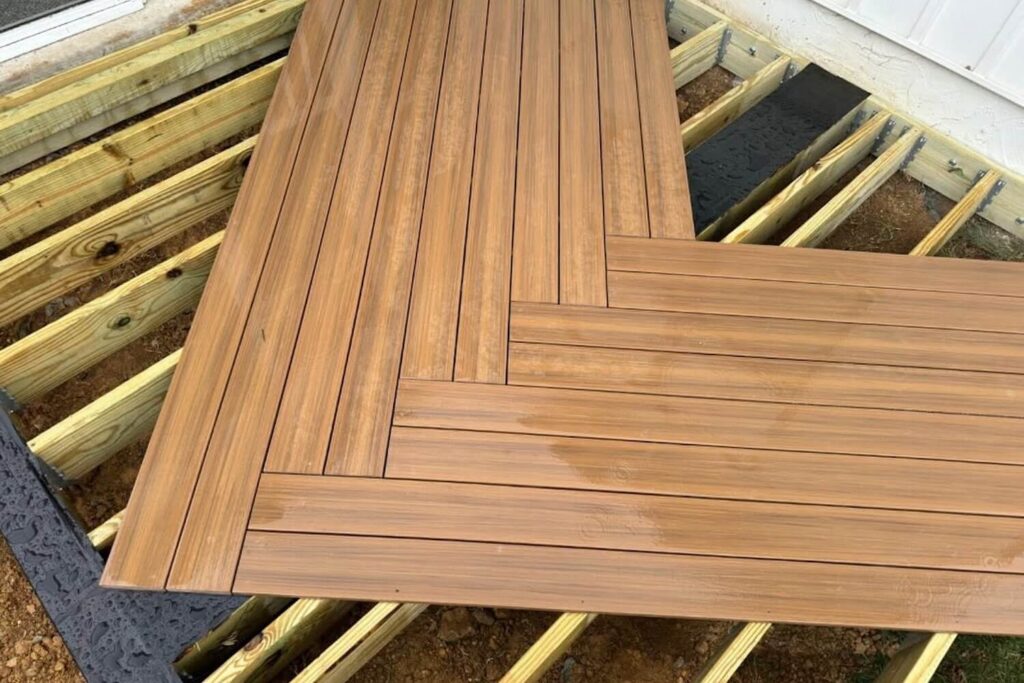
Deck resurfacing, often referred to as re-decking, focuses entirely on replacing the visible surface elements of the deck while preserving the underlying structural frame. During a resurface, old deck boards, stair treads, railings, and fascia trim are carefully removed. The remaining framing skeleton is then inspected, reinforced, and prepared. Finally, we install brand-new decking boards, modern railing systems, and fresh trim directly on top of the original structure.
What is Deck Replacement?
A full deck replacement is a complete demolition of the entire structure down to the ground. The posts are removed, footings are dug up, and the ledger board connected to the home is detached. The entire structure is then rebuilt from the ground up, starting with new footings, new support framing, and a brand-new surface.
The Financial and Practical Advantage
If your deck’s underlying framing remains structurally sound, resurfacing offers a massive advantage. Because you are reusing the existing concrete footings, main support beams, and joist network, which account for a significant portion of labor and framing lumber costs, resurfacing can cost 30% to 50% less than a total replacement. Furthermore, resurfacing projects can often be completed in just a few days, minimizing disruption to your yard and routine.
Surface-Level Red Flags: When Deck Resurfacing is the Right Choice
If the wear and tear on your deck is isolated to the top layer while the frame underneath remains dense and healthy, resurfacing is the ideal solution. Here are the primary surface warning signs that indicate your deck is a prime candidate for a refresh:
1. Widespread Splintering, Checking, and Cracking
As pressure-treated lumber ages, UV radiation breaks down the natural polymers within the wood grain, while moisture causes repeated expansion and contraction. This results in “checking”, long cracks running along the direction of the grain, and sharp splinters. If your deck has become uncomfortable or unsafe to walk on barefoot, but the boards remain structurally supported, replacing those surface planks gives you a fresh start.
2. Excessive Board Warping, Cupping, or Twisting
When wood boards absorb unequal amounts of moisture, they can warp upward at the edges (cupping) or twist out of alignment. Warped boards create uneven walking surfaces that trap standing water and present tripping hazards. Removing cupped boards and replacing them with dimensionally stable materials restores a flat, uniform floor.
3. Faded, Blotchy, or Permanently Stained Appearance
If you have spent years sanding, power washing, and applying coats of stain only to watch the finish peel away after a single season, the wood fibers have likely lost their ability to hold sealants. When a deck reaches its cosmetic end of life, resurfacing allows you to upgrade to low-maintenance materials without paying for an entirely new foundation.
4. Loose Boards and Popping Fasteners
Nails and screws can push upward as wood shrinks and expands over time. If fasteners are popping up across the deck or boards feel springy because screw holes have stripped out, the surface boards have loosened their grip. As long as the joists underneath are dry and dense enough to hold new fasteners securely, resurfacing solves the problem.
The Opportunity to Upgrade Material Science
Choosing to resurface is the perfect time to break free from the cycle of wood maintenance. Instead of replacing old lumber with new pressure-treated boards that will eventually crack again, homeowners can upgrade to advanced, wood-free composite or mineral-based decking.
Modern mineral-based composite technology absorbs virtually no moisture, will never rot or splinter, and features slip-resistant surface textures. Capped composite materials made with eco-friendly recycled content eliminate the need for painting, staining, or chemical sealing, turning an aging wood deck into a virtually maintenance-free retreat.
Deep Structural Danger Signs: When Full Deck Replacement is Unavoidable
While resurfacing is a fantastic option, putting new composite boards on top of a compromised, rotting frame is a dangerous and expensive mistake. If the substructure has failed, the new surface boards will sag, shift, or collapse along with the old frame.
If you observe any of the following critical warning signs during an inspection, a full deck replacement is required:
Critical Structural Danger Signs
- Soft, Spongy Joists & Beams: Wood crumbles or probes easily, indicating internal rot.
- Ledger Board Separation: Gaps appear where the deck attaches to the home’s rim joist.
- Post-To-Ground Rot: Support posts sitting in damp soil show decay at the base.
- Corroded Hardware & Missing Connectors: Flaking, rusted joist hangers and missing structural screws.
- Settling or Cracked Footings: Piers shifting out of level, causing visible sagging.
1. Soft, Spongy Wood in Joists or Beams
In damp environments or areas beneath trees where leaves trap moisture, organic wood rot can take root inside structural framing. Take a screwdriver or ice pick and press it firmly into the tops and sides of the joists, particularly where two boards meet. If the metal tool sinks easily into soft, crumbling wood, decay has compromised the structural integrity of the frame.
2. Separation or Flashing Failure at the Ledger Connection
The ledger board, the critical structural beam that bolts the deck to your home’s rim joist, is responsible for supporting half the total weight of the deck. If water has penetrated behind the ledger board due to improper metal flashing, water rot can weaken both the ledger and the home’s framing. Visible gaps between the house and the deck, water stains on interior basement walls, or rusting ledger bolts indicate severe structural risk that warrants a full rebuild.
3. Rotting Support Posts at Ground Level
Older decks were frequently constructed with wooden support posts set directly into concrete holes or buried in damp topsoil. Over time, ground moisture wicks into the base of the post, causing the wood to rot from the inside out at soil level. If support posts are soft, leaning, or visibly decaying at the ground line, the foundation is no longer capable of carrying heavy structural loads.
4. Widespread Fastener Corrosion and Missing Hardware
Older decks were often built using standard smooth nails or basic steel fasteners that rust when exposed to moisture and pressure-treated wood chemicals. If metal joist hangers are flaking away with rust, structural bolts are heavily corroded, or critical brackets are missing entirely, the load connections are failing. Rebuilding allows for the installation of modern, heavy-duty stainless steel or double-galvanized connectors.
5. Settling, Shifting, or Cracked Concrete Footings
East Tennessee clay soils expand and contract significantly with moisture changes and seasonal freezing. If concrete footings were poured shallowly above the local frost line, winter freezes can cause the piers to heave or sink unevenly. A deck with visibly unlevel posts, sagging beams, or cracked footings requires new foundation engineering.
Anatomy of a Professional Deck Inspection and Build Standard
Evaluating whether a deck frame can safely support another 25 to 50 years of use requires a thorough inspection. Specialized local contractors like LeBlanc Decks emphasize a comprehensive inspection of all hidden components before recommending resurfacing over replacement.
When a structure is evaluated for resurfacing, a rigorous checklist must be satisfied:
- Joist Spacing Verification: Traditional wood decks were often framed with joists spaced 24 inches apart on center. Modern composite and mineral-based boards require a sturdier sub-frame with joist spacing no wider than 16 inches (or 12 inches for diagonal board layouts) to prevent flexing. If existing joists are spaced too far apart, sister joists must be added to reinforce the frame.
- Framing Material Quality: A long-lasting resurface relies on high-grade lumber. Standard wet lumber shrinks and twists as it dries in the sun, pulling surface fasteners loose. Premium builds utilize Kiln-Dried After-Treatment (KDAT) lumber, which is fully dried in kilns before installation so the framing stays flat, straight, and stable for decades.
- Foundation Elevation: Rather than setting posts in damp ground or basic concrete pours, modern structural standards utilize mechanical pile footings or helical steel piers. These deep mechanical footings reach down to stable load-bearing soil, anchoring the structure securely while keeping all structural wood elevated safely above soil moisture.
- Joist Protection Flashing: Applying protective waterproof flashing tape along the top edge of existing joists before installing new boards seals old screw holes and prevents standing water from penetrating the top of the wood frame, significantly extending the frame’s lifespan.
The Homeowner Experience: What to Expect During the Home Deck Project
Whether you choose to resurface or replace your deck, the process should be organized, transparent, and reassuring. Homeowners in Maryville deserve clear communication through every stage of construction.
When you work with an elite deck specialist, the project follows a disciplined methodology:
- Onsite Evaluation: A certified specialist performs a thorough structural review to assess frame density, footing stability, and ledger attachments, determining whether resurfacing or replacing makes the most financial sense.
- Clear Design and Proposal: You receive an itemized proposal outlining material choices, color palettes, railing styles, and structural details before any work begins.
- Digital Project Portal: Through a process-driven approach, LeBlanc Decks gives homeowners full visibility into their build through a private online customer portal. Clients can review project schedules, access documents, send direct messages, and view daily job logs featuring workday photos uploaded directly by the construction crew.
- Flawless Build Execution: Professional crews handle job site clean-up daily, ensure no raw wood edges remain exposed, and utilize hidden fastener systems for a smooth, seamless finish.
- Final Walkthrough and Warranty Protection: The completed project is inspected alongside the homeowner to verify that every detail meets rigorous standards, backed by robust labor and material warranties.
Frequently Asked Questions (FAQ)
How do I know if my deck joists are too rotted to resurface?
You can perform a simple probe test using an ice pick or screwdriver. Press the metal tip into multiple areas along the top and bottom of the joists, especially near attachment brackets and ends. If the tool penetrates easily into soft, spongy, or crumbling wood, internal decay is present, and the framing must be replaced.
Can I replace wooden deck boards with composite boards on my existing frame?
Yes, provided the underlying joists, beams, ledger, and footings are structurally sound and dry. However, you must verify joist spacing first. Traditional wood boards can span wider gaps, whereas most composite and mineral decking require joists spaced no more than 16 inches apart on center (or 12 inches for diagonal patterns). Extra framing support can be added during resurfacing if needed.
How much cheaper is deck resurfacing compared to a full deck replacement?
Resurfacing typically saves homeowners 30% to 50% compared to a full rebuild. Because you are preserving the concrete footings, support posts, main beams, and ledger connection, you eliminate significant demolition, excavation, and structural framing material costs.
Do I need a building permit in Maryville, TN, to resurface my deck?
In most municipalities, replacing surface boards and railings on an existing, unchanged footprint without altering structural framing is considered a cosmetic repair and may not require a full structural permit. However, if you add square footage, modify support joists, or rebuild stairs, a building permit is required. An experienced local builder handles municipal permitting requirements on your behalf.
How long does a deck resurfacing project typically take to complete?
Because the time-consuming tasks of digging footings and building the primary support frame are already done, a standard residential resurfacing project can often be completed in just 2 to 4 days, compared to 1 to 3 weeks for a complete replacement.
Deck Conclusion: Restore Your Outdoor Sanctuary
Deciding whether to resurface or replace your Maryville deck comes down to an honest evaluation of what lies beneath the surface. If your deck frame is rotting, shifting, or structurally compromised, investing in a complete rebuild is necessary to protect your family’s safety. However, if your joists, beams, and footings remain dense, level, and solid, resurfacing is a brilliant, cost-effective way to achieve a brand-new, low-maintenance outdoor space at a fraction of the cost.
By upgrading your worn wooden surface to modern mineral-based composite decking, powder-coated aluminum railings, and integrated low-voltage lighting, you can turn an aging backyard burden into a stunning, low-maintenance retreat that enhances your home’s value for decades.
Partnering with an experienced team like LeBlanc Decks ensures your project receives the structural care and craftsmanship it deserves. From precision 50-point inspections to transparent daily photo updates, every detail is engineered for long-term performance. Contact us today to schedule your complimentary design consultation, leave the splinters behind, and reclaim the outdoor living space you deserve.